
Insight
Beyond Blockchain: Why Physical Fingerprinting is the Missing Link in Supply Chain Authentication
Tags

The supply chain security industry has embraced blockchain technology as the definitive solution to counterfeiting. The promise is compelling: immutable records, distributed trust, cryptographic security. Yet despite widespread blockchain adoption, counterfeit products continue infiltrating supply chains at alarming rates.
The fundamental issue is this: blockchain excels at recording digital transactions, but it cannot independently verify whether the physical product being scanned is genuine or counterfeit. This blind spot has created a critical vulnerability that sophisticated counterfeiters actively exploit.
The Scale of the Problem
Global counterfeiting costs the economy £392 billion annually. The European Union detained 152 million counterfeit articles in 2023—a 77% increase from the previous year. China and Hong Kong account for over 80% of these counterfeits, with 25% of counterfeit electronics involving active components available through authorised distribution channels.
The Electronic Resellers Association International documented 1,055 suspect counterfeit parts in 2024, marking a 25% increase and the highest level since 2015. The most concerning finding: 80.5% were new counterfeits never previously identified, indicating rapidly evolving techniques that circumvent existing authentication systems.
If blockchain technology were solving the problem, these numbers should be declining. Instead, they continue rising.
Understanding Blockchain’s Fundamental Limitation
Blockchain operates on a core principle: once data is recorded, it cannot be altered. This immutability is simultaneously its greatest strength and its critical weakness for physical supply chain applications.
Consider this scenario, which occurs more frequently than industry would prefer to acknowledge:
A counterfeiter produces high-quality fake aerospace components and generates authentic-appearing QR codes. These components enter the supply chain through compromised or negligent intermediaries. Someone scans them and registers them on a blockchain authentication system.
The blockchain performs exactly as designed: it creates an immutable, cryptographically secured, distributed record of this component moving through the supply chain. Every subsequent scan adds another verified transaction to the permanent ledger.
The result? Advanced technology has been used to permanently authenticate counterfeit products.
The Portuguese airline incident exemplifies this vulnerability. Investigation revealed a jet engine vibration damper was counterfeit despite having falsified documentation that appeared legitimate. The paperwork was perfect, the records were “authenticated,” but the component was fake and posed a serious safety risk.
Technical and Practical Constraints
Beyond the fundamental authentication problem, blockchain faces practical limitations:
Scalability Issues: Even with advanced Layer 2 solutions, blockchain systems achieve only 2,000-10,000 transactions per second. Modern electronics manufacturing facilities can produce tens of thousands of components per hour, each requiring individual authentication and tracking. The throughput simply doesn’t match manufacturing reality.
Energy Consumption: Blockchain verification requires 0.1-100 watt-hours per transaction depending on the consensus mechanism. When processing millions of daily supply chain events, environmental and operational costs become prohibitive. This explains why adoption remains below 5% in actual production systems despite extensive industry promotion.
The Oracle Problem: Blockchain relies on external data sources to input information about physical products. This human or sensor-mediated input represents a trust boundary where fraud can occur. If the initial data entry is compromised, the entire blockchain record becomes a permanent, cryptographically validated lie.
Comparative Authentication Technologies
The supply chain authentication landscape includes several distinct approaches, each with specific advantages and limitations:
Traditional Methods (QR Codes, RFID): These dominate current implementations due to low costs (£0.0008-1.60 per unit) and universal compatibility. However, they offer minimal security against determined counterfeiters who can replicate the physical carriers and register them in blockchain systems before genuine products are authenticated.
Physical Unclonable Functions (PUF): Silicon PUFs exploit natural manufacturing variations in semiconductors to create unclonable device fingerprints. They achieve exceptional security (false acceptance rate <0.001%) with minimal overhead (<1% silicon area). However, PUF technology requires integration into semiconductor design, limiting application to electronic components rather than finished products or packaging.
Physical Fingerprinting: Technologies like Fibrecode® represent a fundamentally different approach. Rather than adding security features to products, these systems leverage the naturally occurring random fibre distribution inherent within substrates—such as paper, cardboard, or composite materials. Additional fibres can be introduced during production when needed, but the core principle exploits the mathematical impossibility of replicating true random distributions.
This approach creates three-dimensional physical fingerprints verified using machine vision with standard imaging equipment. The random fibre patterns cannot be duplicated, even by the original manufacturer using identical processes and materials.
The Integrated Solution: Physical Authentication as Foundation
The evidence from implementation studies is clear: physical authentication combined with blockchain delivers superior results compared to either approach alone.
Measured Outcomes:
- Physical + Blockchain: 92% reduction in counterfeit products
- Blockchain only: 40-50% reduction
- Physical authentication only: 75-85% reduction
This performance difference stems from addressing the fundamental vulnerability. Physical authentication establishes verified authenticity before any blockchain record is created. The physical fingerprint is captured and verified at the point of manufacture, generating a cryptographic certificate that is then registered on the blockchain.
Subsequent supply chain checkpoints re-verify the physical fingerprint before recording any blockchain transaction. Any discrepancy between the physical reality and the blockchain record immediately identifies a counterfeit product.
Business Impact: Organisations implementing integrated physical-to-blockchain authentication report:
- 25% revenue recovery from previously lost sales
- 50% reduction in warranty costs
- 20-30% overall supply chain cost reduction
- Payback periods of 6-24 months despite initial investments of £800,000 to £3.2 million
Implementation Architecture
A robust physical-to-digital authentication system integrated with blockchain comprises several interconnected layers:
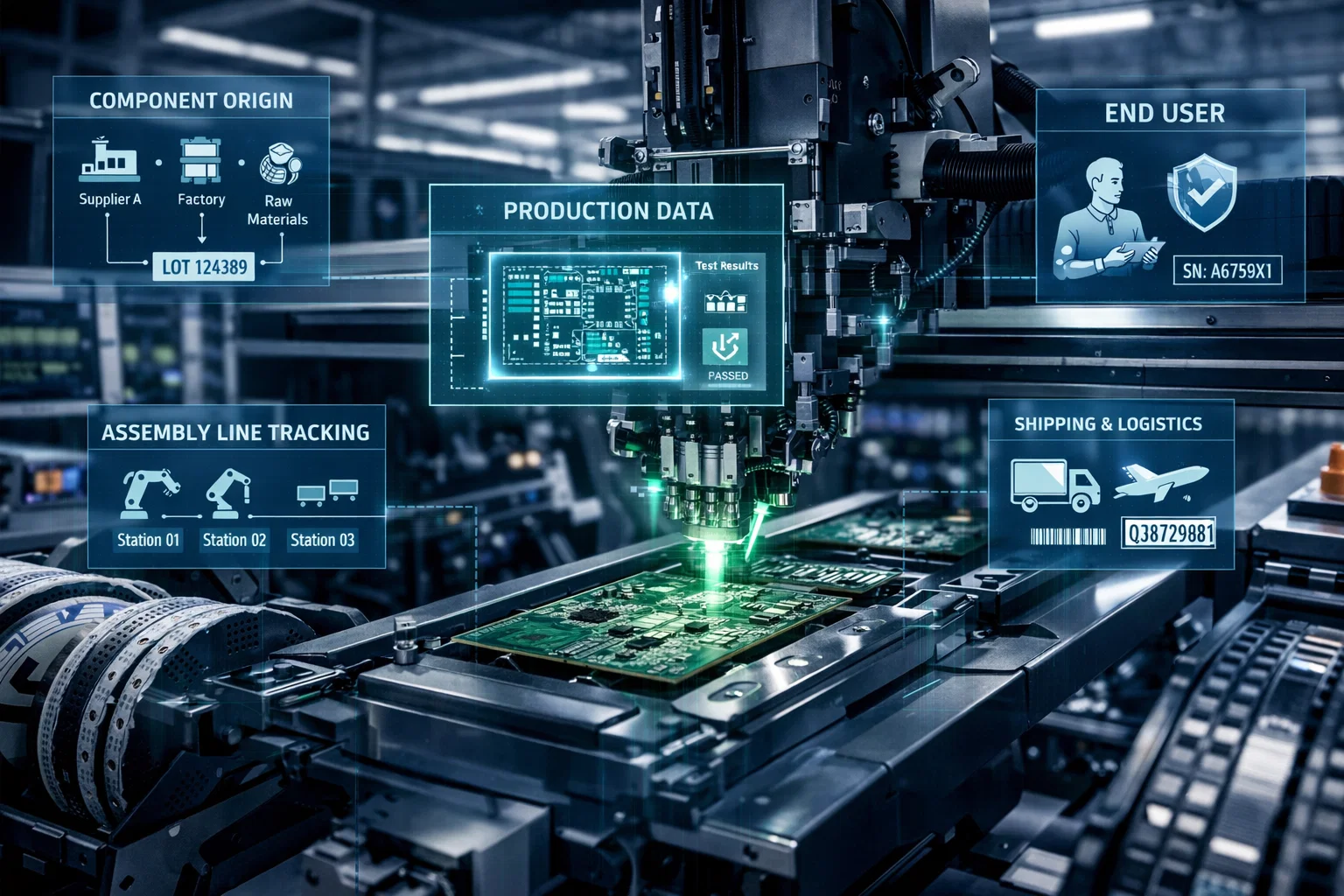
Manufacturing Integration: Physical fingerprints are captured during production using standard imaging equipment. Automated systems generate digital signatures and create cryptographic certificates before initiating blockchain registration. This ensures only verified authentic products receive blockchain records.
Supply Chain Verification: Each checkpoint re-verifies physical fingerprints before recording blockchain transactions. Anomaly detection algorithms identify discrepancies, triggering immediate alerts for suspected counterfeits. This continuous verification prevents fraudulent blockchain entries at every stage.
Enterprise Integration: API connectivity enables real-time synchronisation with ERP and PLM systems whilst maintaining role-based access controls. The architecture supports both cloud and on-premise deployments, with hybrid implementations providing optimal balance between security and scalability.
Sector-Specific Results
Aerospace: The discovery of counterfeit jet engine components with falsified documentation highlighted vulnerabilities in traditional authentication methods. Aerospace manufacturers implementing physical fingerprinting have achieved near-complete elimination of counterfeit parts in their supply chains, with particular success in safety-critical components requiring lifetime traceability.
Electronics: Testing laboratories report that 25% of counterfeit cases involve active components available through authorised channels, suggesting counterfeiters have infiltrated legitimate distribution networks. Physical authentication integrated with blockchain tracking has reduced these incidents by 85% in early adopter facilities.
Pharmaceuticals: Although excluded from Digital Product Passport requirements due to existing track-and-trace systems, pharmaceutical manufacturers adopting physical fingerprinting for packaging authentication report 85% reductions in counterfeit detection, with particularly strong results in high-value oncology medications.
Regulatory Imperatives
The regulatory landscape has fundamentally shifted from voluntary guidelines to mandatory requirements with significant penalties for non-compliance:
EU Digital Product Passport (ESPR): Mandatory implementation begins February 2027 for batteries, expanding to textiles, electronics, construction materials, and furniture through 2030. The regulation requires unique product identifiers and authentication features for high-value items—specifications that blockchain alone cannot satisfy.
U.S. Drug Supply Chain Security Act: Full implementation achieved November 2023, requiring package-level serialization with verification capabilities and electronic tracking through the entire distribution chain.
CHIPS and Science Act: £42 billion in semiconductor incentives tied to supply chain verification requirements, including raw material traceability and restrictions on expansion in “countries of concern.”
These regulations explicitly recognise that effective authentication requires physical verification, not merely digital record-keeping. Blockchain serves as infrastructure for recording verified authentications but cannot perform the verification itself.
Industry standards including SEMI T20, IPC-1782, and ISO/SAE 21434 increasingly specify that authentication must be based on physical product characteristics rather than attached identifiers that can be copied or transferred.
The Counterfeiting Arms Race
Counterfeiters represent sophisticated operations that rapidly adapt to authentication measures. The 80.5% rate of new, previously unidentified counterfeits demonstrates their ability to evolve techniques faster than traditional security measures can respond.
Traditional methods like holograms and serial numbers have been successfully copied for years. Blockchain-only systems are now being exploited at the initial entry point. Physical fingerprinting based on true randomness represents a fundamental shift: a physical impossibility rather than merely a technical difficulty.
The random fibre distribution inherent in materials—or introduced during production—cannot be replicated any more than one can duplicate actual human fingerprints from a photograph. This creates authentication based on physics rather than technology, establishing a barrier that cannot be overcome through technical sophistication alone.
Future Technology Convergence
The authentication landscape is evolving toward integrated systems combining multiple technologies:
IoT Integration: Physical authentication devices with embedded sensors provide continuous verification throughout product lifecycles, automatically recording authentication events on blockchain without human intervention.
AI-Powered Verification: Machine learning algorithms analyse physical fingerprints with increasing sophistication, detecting subtle tampering attempts and identifying emerging counterfeiting techniques before they proliferate.
Zero-Knowledge Proofs: Advanced cryptographic methods enable authentication verification without revealing sensitive product information, addressing intellectual property concerns that have previously constrained adoption.
The anti-counterfeit packaging market reached £139-143 billion in 2024, growing at 12-13% annually. This growth is driven by regulatory compliance requirements, brand protection imperatives, supply chain transparency demands, and consumer expectations for product authenticity.
Strategic Implications
Blockchain technology provides valuable capabilities for supply chain transparency and immutable record-keeping. However, empirical evidence demonstrates that blockchain alone cannot prevent counterfeiting because it cannot independently verify physical product authenticity.
Physical authentication technologies—particularly those leveraging natural randomness in material structures—address this fundamental limitation by establishing verified authenticity at the physical-digital boundary. When integrated with blockchain infrastructure, these technologies create authentication systems demonstrably superior to either approach alone.
Organizations implementing integrated physical-to-blockchain authentication achieve 92% counterfeit reduction rates compared to 40-50% for blockchain-only implementations. They transform regulatory compliance from burden to competitive advantage whilst achieving substantial returns on investment, protecting brand reputation, ensuring customer safety, and maintaining market position.
The window for proactive implementation is narrowing. EU Digital Product Passport requirements become mandatory in February 2027. Organizations that act now can implement systems on their terms with planned integration. Those who delay will face accelerated timelines, higher costs, and inferior results whilst scrambling to achieve compliance under regulatory pressure.
The next major counterfeit incident will make headlines. Companies with robust physical-to-digital authentication will demonstrate their commitment to safety and quality. Those relying on blockchain-only solutions may face regulatory action, massive recalls, and lasting brand damage.
The question is not whether to implement physical-to-digital authentication, but rather how quickly your organisation can deploy these systems before facing compliance penalties, liability exposure, or a catastrophic counterfeit failure.