
Insight
Manufacturers: Are You Ready for Traceability?
Tags
If regulators knocked on your door tomorrow and asked you to prove where every component in your product came from, could you?
For most companies, the honest answer is “not really.” And that’s about to become a very expensive problem.
The 79% Problem
Here’s a stat that should concern every manufacturer: whilst 72% of companies have adopted some form of traceability software, a staggering 79% still lack end-to-end supply chain visibility. That gap between “we have something” and “we can actually prove provenance” is where risk lives.
And increasingly, where regulators are looking.
The Regulatory Wave Has Already Hit
Traceability is no longer a “nice to have,” it’s a “must have”. The EU’s Ecodesign for Sustainable Products Regulation entered force in July 2024. Digital Product Passports become mandatory for batteries in February 2027. Textiles and electronics follow shortly after. By 2030, virtually every physical product sold in the EU needs a digital identity.
Meanwhile, the US Drug Supply Chain Security Act hit full implementation in November 2023. The CHIPS Act ties $52.7 billion in semiconductor incentives to supply chain verification. China’s mandatory traceability requirements are expanding rapidly.
This isn’t future speculation. It’s happening now.
What Actually Needs to Change?
The IPC-1782 standard—which I’ve been working on with the Global Electronics Association—breaks traceability into four levels, depending on your product’s risk profile. At minimum, you need to track:
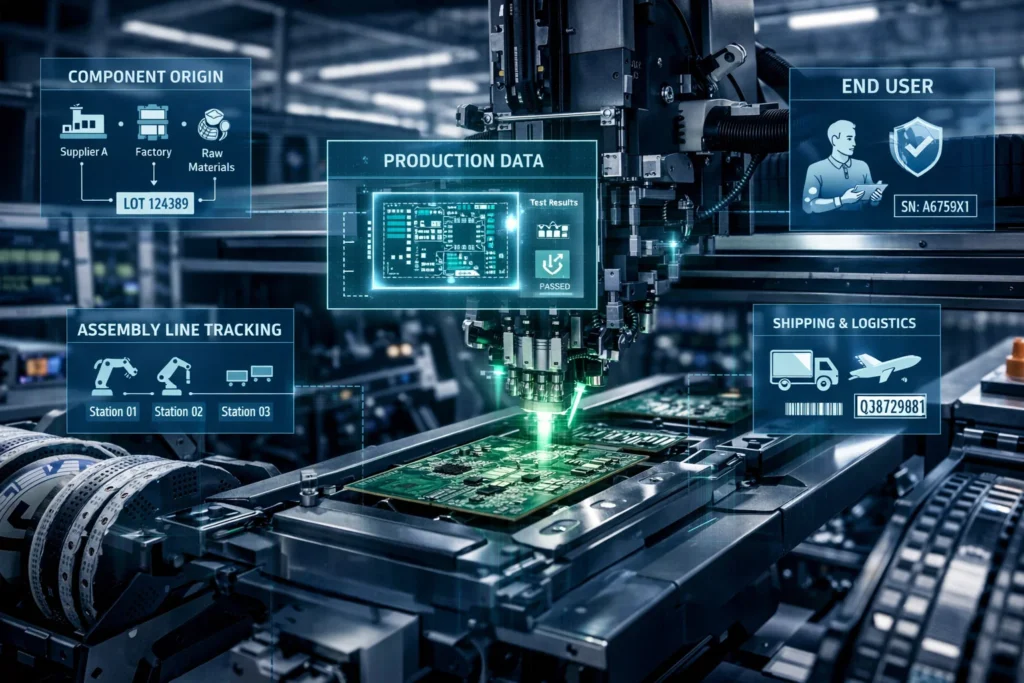
- What came in: Material identification and supplier verification
- What happened to it: Process data and quality records
- Where it went: Logistics and ownership transfers
- What was made: Final product authentication and documentation
Sounds straightforward, right? In practice, it means fundamentally rethinking how you capture, store, and share data across your entire supply chain.
The Real Challenge: Your Suppliers
The hardest part of Traceability isn’t your own systems. It’s getting your suppliers on board.
I’ve seen this firsthand. You can have the most sophisticated blockchain platform in the world, but if your Tier 2 suppliers are still using spreadsheets (or worse, paper), your traceability chain breaks at the weakest link.
This is why we’ve partnered with Stewart Technology through a Scottish Enterprise grant award to build the first truly IPC-1782 compliant blockchain platform for the electronics manufacturing industry. We’re not just building technology—we’re proving it works in real manufacturing environments where components come from dozens of suppliers and often multiple countries.
The Numbers That Should Get Your Attention
Let me share some data that reframes traceability from “cost centre” to “strategic investment”:
- Companies implementing comprehensive traceability achieve 85-92% reductions in counterfeit incidents
- Supply chain costs drop by 20-30% through improved visibility
- Product recall speed improves by 73%
- Customer trust metrics increase by 65%
- Typical ROI: 150-500% over five years
That last figure isn’t a typo. Early adopters aren’t just meeting compliance—they’re turning traceability into competitive advantage through premium pricing, reduced warranty costs, and access to sustainability-focused markets.
The SME Question
“But we’re not a multinational with millions to spend on this.”
Here’s the reality: SME adoption of traceability solutions jumped 48% between 2022 and 2024. More than 4,300 small and medium manufacturers implemented systems last year alone.
Why? Because the technology has matured. Cloud-based platforms have made implementation accessible to organisations of all sizes. Blockchain provides the immutable, decentralised trust layer that ensures data integrity across complex supply chains. And critically, authentication technologies have evolved beyond basic barcodes and serial numbers.
The real question isn’t “can we afford traceability?” It’s “can we afford to be locked out of major markets because we lack it?”
Where to Start
If you’re reading this thinking “we need to do something,” here’s my practical advice:
First, know your regulatory exposure. Which markets do you sell into? What deadlines apply to your product categories? Battery manufacturers have until February 2027. Textiles until summer 2027. Electronics somewhere in between.
Second, assess your current state honestly. Map what traceability you already have against established and emerging standards. Most companies discover they’re doing better than they thought in some areas and worse in others.
Third, start with your biggest risk. You don’t have to implement everything at once. Identify the products or components where counterfeiting, quality failures, or regulatory non-compliance would hurt most. Start there.
Fourth, engage your suppliers early. This takes longer than the technology implementation. Begin conversations now about data sharing requirements and timelines.
Fifth, consider the broader opportunity. Traceability isn’t just about avoiding penalties. It’s about building the digital infrastructure that enables circular economy models, premium brand positioning, and operational efficiency.
The Clock Is Ticking
A Deloitte study found that only 26% of manufacturers qualify as “Frontrunners” who’ve fully embraced traceability. More than half are “Followers”—they understand the value but haven’t acted. And 23% are “Stragglers” at serious risk of being left behind.
Which category describes your organisation?
For electronics manufacturers, for example, the pressure is already here. Customer requirements for traceability and sustainability compliance are tightening now, and the EU’s Digital Product Passport requirements for electronics are expected by 2028—just two years away. That’s not much time when you factor in technology selection, supplier onboarding, system integration, and process redesign. Companies that start now will be positioned to win contracts that demand traceability compliance. Those waiting will find themselves locked out of opportunities—or scrambling to catch up.
Our Bet on Standards-Compliant Traceability
At Septillion, we’ve made a deliberate choice to build our platform on open standards rather than proprietary approaches. Whether it’s IPC-1782 for electronics, GS1 standards for supply chain identification, or emerging Digital Product Passport requirements, our architecture is designed to support multiple frameworks—because real-world supply chains don’t operate in single-standard silos. Why? Because we believe the future belongs to interoperable, standards-based systems that can connect across supply chains, not walled gardens that lock customers in.
The Scottish Enterprise partnership lets us prove this approach works in real manufacturing environments. Stewart Technology faces the same challenges every contract electronics manufacturer does: component authentication, regulatory compliance, supply chain visibility, sustainability documentation. Their production floor is our proving ground.
When we succeed, we’ll have demonstrated that blockchain-based, standards-compliant traceability isn’t just theoretical—it’s practical, affordable, and ready for industry-wide adoption.
The Bottom Line
Traceability is no longer optional. The regulatory frameworks are in place. The technology is mature. The early adopters are already capturing competitive advantage whilst others wait.
The question isn’t whether you’ll implement traceability. It’s whether you’ll do it on your own terms, with time to optimise and learn, or whether you’ll be forced into rushed compliance when deadlines loom.
It’s obvious which approach will lead to better outcomes.
If you’re thinking about where to start, get in touch for a chat. Whether you choose to work with us or not, the conversation about your specific situation is worth having.