
Insight
The Convergence Revolution: When IoT, AI, Blockchain, and Physical Authentication Finally Work Together
Tags

Something remarkable is happening in supply chains across the globe. Technologies that have been developing separately—IoT sensors, artificial intelligence, blockchain networks, and physical authentication—are finally starting to work together seamlessly. And the results are nothing short of transformative.
This convergence has been developing over the past few years, and we’re now witnessing the emergence of truly intelligent, self-verifying supply chains. These systems can authenticate products, spot counterfeits that would fool human inspectors, track environmental conditions, and maintain immutable records without human intervention. What once seemed like science fiction is now operational reality in factories from Germany to Singapore.
Beyond the Hype: What Convergence Actually Means
The industry has seen numerous promises about “revolutionary supply chain technologies” over the years. Typically, these involve implementing one new system that supposedly solves everything. The reality proves both messier and more interesting.
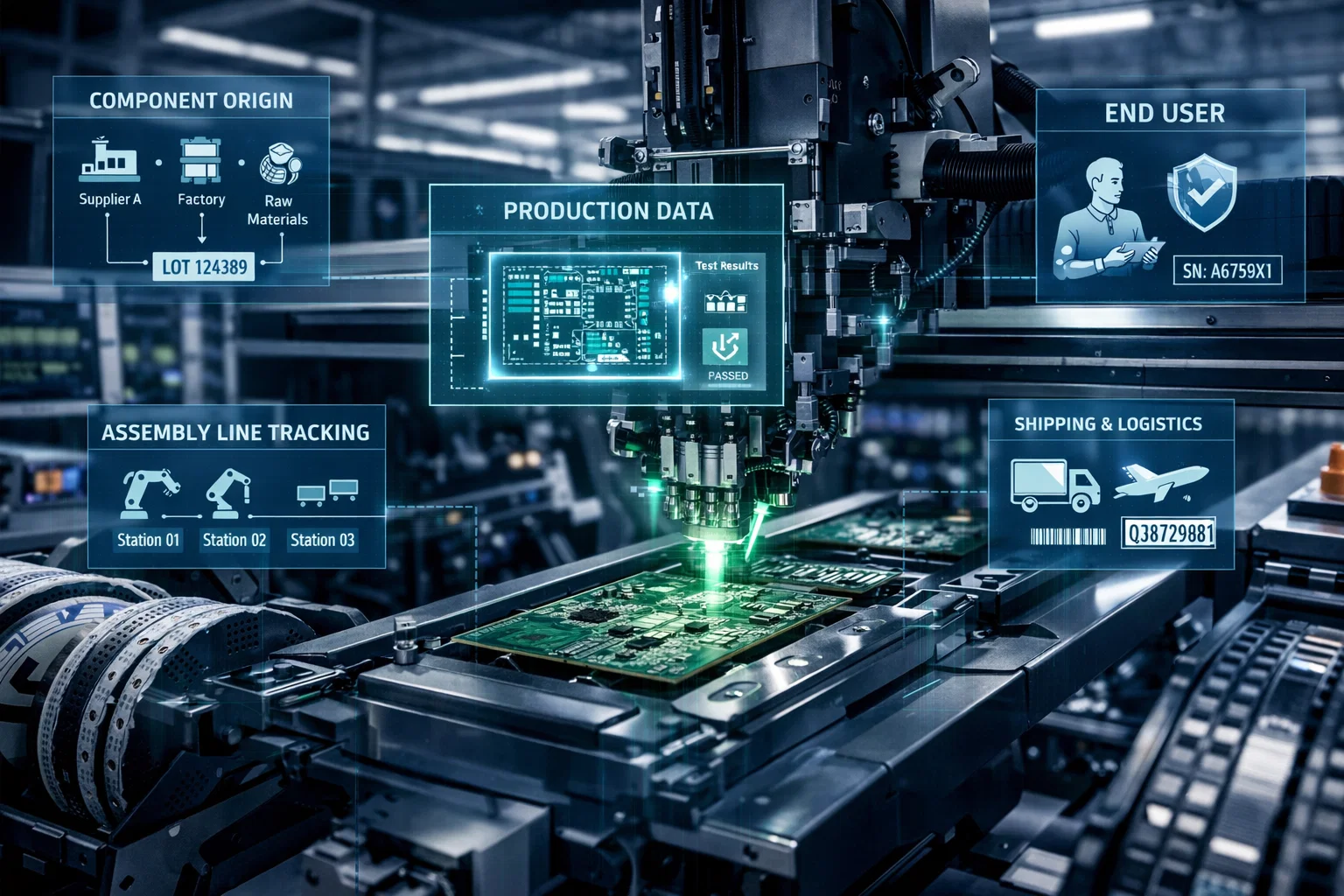
True convergence doesn’t require replacing existing infrastructure. Instead, it creates systems where IoT sensors provide the eyes and ears, AI provides the brain, physical authentication provides the unique identity, and blockchain provides the trustworthy memory. Each technology excels at its core function, and together they create capabilities none could achieve independently.
A recent deployment at a pharmaceutical manufacturer across their European distribution network demonstrates this approach effectively. Their temperature sensors monitor cold chain integrity whilst being cryptographically linked to physical product identifiers, with every temperature reading recorded on an immutable blockchain ledger. AI algorithms analyse patterns across thousands of shipments, learning to distinguish between normal temperature fluctuations and the subtle patterns that indicate tampering or counterfeit infiltration.
When shipments arrive at pharmacies, a simple scan verifies not only product authenticity but also proper storage throughout the entire journey—whilst the AI flags any anomalies that human inspectors would likely miss.
The results speak for themselves: 99.7% authentication accuracy with zero false negatives over twelve months. Cold chain violations dropped by 73% through real-time detection and response rather than post-audit discovery. Most significantly, the AI identified 23 attempted counterfeit infiltrations that would have passed traditional inspection—counterfeits sophisticated enough to fool trained quality control staff.
The Technology Stack That Actually Works
Years of observing implementation challenges across different companies has revealed a clear architecture that consistently delivers results.
The Physical Layer: This is where our Fibrecode® technology sits alongside other physical authentication methods. Think of it as the product’s DNA—absolutely unique, impossible to replicate, but meaningless without the intelligence layers above it.
The Sensing Layer: IoT sensors monitor everything that matters—temperature, humidity, location, tamper attempts. But here’s the key: they’re not just collecting data, they’re providing cryptographically signed evidence that can be verified later.
The Verification Layer: This is where blockchain shines. Every sensor reading, every authentication event, every hand-off between supply chain partners gets recorded with unforgeable timestamps and digital signatures. No more “he said, she said” disputes about what happened when.
The Intelligence Layer: AI transforms the entire system capability. Machine learning algorithms analyse patterns and learn from every authentication attempt, sensor reading, and supply chain event. Patterns that appear as normal variation to human analysts reveal themselves as sophisticated counterfeiting attempts when algorithms process millions of data points simultaneously. AI systems can detect counterfeit electronics through microsecond timing differences in component responses that remain imperceptible to human analysis.
The synergy between these layers creates unprecedented security. Whilst a counterfeit product might fool one layer—perhaps even two—successfully deceiving all four simultaneously moves from difficult to virtually impossible. The AI component proves particularly crucial because it continuously learns new counterfeit techniques and shares that knowledge across the entire network. When a new counterfeiting method appears in Tokyo, every authentication system in the network learns to identify it within minutes.
Real-World Results That Matter
Performance data provides clearer evidence than theoretical capabilities. An aerospace manufacturer has deployed converged authentication across their critical component supply chain, now identifying suspect counterfeit parts before production integration—47 components intercepted over 18 months that might otherwise have reached commercial aircraft. The AI component has proven transformative, identifying counterfeits that pass visual inspection, magnetic testing, and basic electrical testing. Algorithms detect microscopic differences in metal grain structure that indicate non-standard manufacturing processes.
Beyond counterfeit detection, their authentication cycle time decreased from 45 minutes to 2 minutes through automated verification processes. The AI makes preliminary authenticity determinations in milliseconds, flagging only genuinely suspicious components for human review.
In consumer electronics manufacturing, tier-3 supplier visibility reached 85% of components. This capability enables tracing defective capacitors back to specific batches from original suppliers, not merely immediate vendors. Quality improvements followed naturally: defect rates declined 34%, warranty claims decreased 28%. The AI contribution extends beyond tracking—it now predicts quality issues before occurrence, analysing subtle patterns in supplier performance, environmental conditions, and component behaviour that indicate impending failures.
The Challenges Worth Addressing
Implementation presents genuine obstacles that require strategic consideration rather than dismissal.
Data Volume Management: IoT sensors generate substantial data—1-10 GB monthly per monitored product. Complete blockchain storage would exceed both budget and performance requirements. The solution involves intelligent edge filtering, recording only authentication-critical events whilst maintaining complete audit capabilities.
AI Training Requirements: Machine learning models require extensive datasets, yet supply chains naturally generate sparse data for critical events like counterfeiting attempts. Federated learning addresses this challenge, enabling AI systems to share insights across companies without exposing sensitive data. This approach creates collective intelligence for global supply chain security.
Algorithm Bias and Fairness: AI systems can inadvertently discriminate against legitimate suppliers based on geographical location, company size, or other irrelevant factors. Careful validation procedures ensure authentication algorithms focus exclusively on genuine risk indicators.
Integration Complexity: Most enterprises maintain decades of legacy systems that weren’t originally designed for interoperability, much less integration with blockchain networks or AI platforms. Success requires middleware that handles multiple protocols—REST APIs, JSON-LD data formats, and message queues that manage translation between systems whilst feeding clean data to machine learning models.
Standards Fragmentation: IoT protocols span numerous variations (LoRaWAN, NB-IoT, Sigfox), blockchain platforms offer different capabilities, AI frameworks vary significantly, and physical authentication methods use diverse data formats. Current standardisation remains incomplete, making flexibility and future-proofing essential considerations.
Security Complexity: Converged systems with AI components present multiple attack surfaces beyond traditional solutions. Requirements include hardware security modules for cryptographic keys, intrusion detection for anomalous patterns, adversarial attack protection for AI models, and zero-knowledge proofs for privacy protection. Implementation demands sophisticated expertise across multiple domains.
The Economics Make Sense
Despite implementation complexity, the financial proposition proves compelling. Total cost of ownership typically ranges from £8-35 per monitored product over three years, including hardware, connectivity, AI platform services, and model training costs. This investment delivers:
- 99.95% authentication accuracy with false positive rates below 0.01%
- Real-time verification in 50-300 milliseconds
- AI-powered predictive analytics that prevent quality issues before they occur
- Automated compliance reporting that cuts audit preparation costs by 40-60%
- Supply chain visibility that prevents quality issues before they become customer problems
Most implementations achieve positive returns within 18-36 months. High-value or high-risk products often demonstrate faster payback periods of 12-24 months through immediate loss prevention and operational efficiency gains.
What’s Coming Next
The convergence acceleration continues, with AI serving as the primary catalyst. 5G networks enable near-instantaneous authentication with sub-10 millisecond response times, optimal for AI models requiring real-time inference. Edge AI chips bring machine learning directly to IoT sensors, enabling authentication decisions at the point of sensing without cloud connectivity requirements. Advanced AI techniques like generative adversarial networks create increasingly sophisticated counterfeit detection capabilities, whilst quantum machine learning algorithms promise authentication capabilities that currently seem impossible.
Most significantly, AI democratises convergence access for smaller organisations. Companies no longer require teams of PhD data scientists to deploy effective authentication algorithms—cloud-based AI services provide sophisticated capabilities through accessible APIs.
The regulatory environment creates powerful implementation incentives. EU Digital Product Passport requirements, pharmaceutical serialisation mandates, and defence supply chain security regulations extend beyond compliance obligations—they drive the standardisation and interoperability that makes convergence practical at scale.
Companies initially focused on counterfeiting solutions discover they’ve built foundations for predictive maintenance, demand forecasting, and circular economy business models. When complete product lifecycle tracking combines cryptographic certainty with AI-powered insights, previously unanticipated possibilities emerge. AI doesn’t merely authenticate—it predicts, optimises, and learns continuously.
The Strategic Imperative
Convergence represents more than a technology opportunity—it’s becoming a competitive necessity. Supply chains capable of proving authenticity, environmental compliance, and ethical sourcing in real-time will capture market share from those that cannot.
Companies implementing converged authentication today build capabilities their competitors will struggle to match. They create trust relationships with customers, partners, and regulators that become increasingly valuable as transparency expectations rise.
The convergence revolution doesn’t wait for perfect standards or complete solutions. It’s operational today with current technologies, in factories and warehouses worldwide. The question isn’t whether it will transform industries—it’s whether organisations will lead that transformation or struggle to catch up.
The convergence of IoT, AI, blockchain, and physical authentication isn’t just changing how we verify products. It’s changing how we think about intelligence, trust, transparency, and truth in an increasingly complex world. And that’s a revolution worth joining.